Scuba vs snorkeling vs freediving
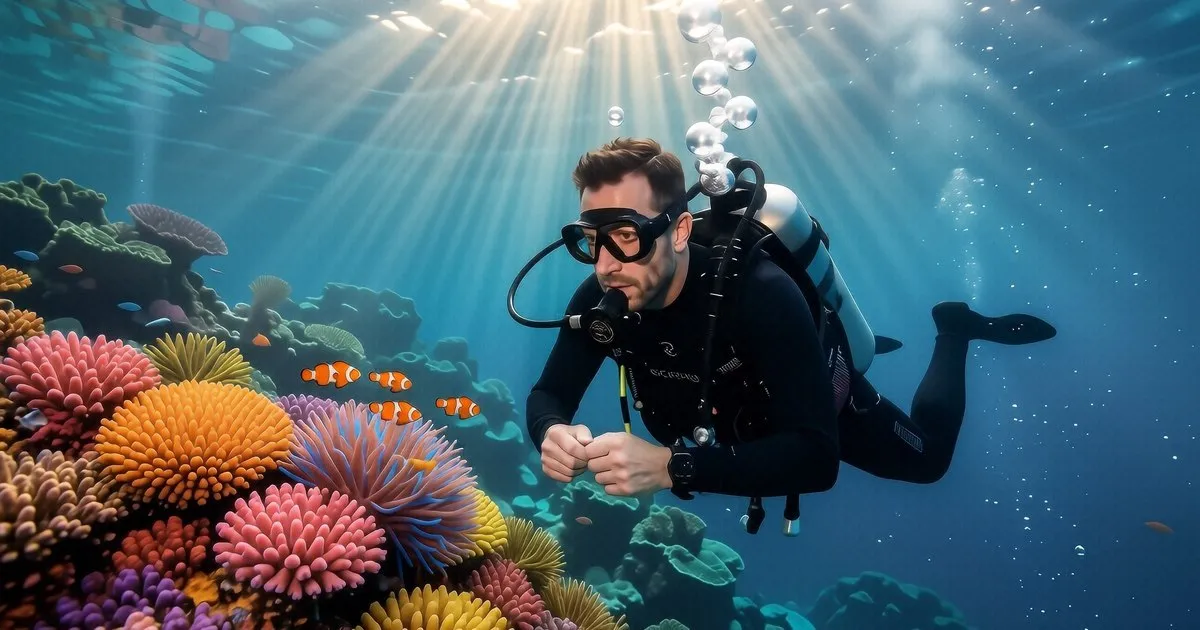
The surface perspective
Snorkeling is simple. You stay on the surface because your lungs provide all the air you need. Most people use a mask, a snorkel, and fins to observe the reef from above. It requires very little training or expensive gear. You can buy a basic set at a local shop for $30 USD.
It is easy.
I remember snorkeling in Anilao back in 2016. The visibility was only 5m, so I stayed very close to the surface. While the macro life is better underwater, the shallow reefs still offer plenty of color. You see fish, turtles, and coral without any technical stress.
What is scuba?
Scuba means Self-Contained Underwater Breathing Apparatus. This system uses a tank and a regulator to deliver air at ambient pressure. It allows you to stay submerged for long periods. You are no longer limited by your breath.
Depth changes everything.
When you dive, you enter a three-dimensional world. You can descend to 18m or even 30m on a standard recreational dive. This is why people choose scuba diving over surface swimming. You see the underside of reefs and creatures that hide in crevices.
It requires skill.
Learning what is scuba involves understanding physics and safety. You must learn to equalize your ears as pressure increases. Agencies like PADI or SSI teach these essential skills through structured courses. Without proper training, the risks of nitrogen narcosis or decompression sickness become real.
Freediving vs snorkeling
Freediving is different. It is the art of breath-hold diving without any tanks. While snorkeling keeps you on the surface, freediving takes you down using only your lungs. It is a mental game as much as a physical one.
It feels quiet.
Many divers find that freediving vs snorkeling offers a much more intimate connection to the ocean. You move silently through the water column because there are no loud bubbles from a regulator. This silence often attracts curious marine life. I once spent 45 seconds at 12m depth in Komodo while observing a sea turtle.
Training is necessary.
Do not try to dive deep without a coach. Freediving requires specific techniques to manage CO2 buildup and prevent blackouts. Professional instructors teach you how to relax your diaphragm so that you can extend your time underwater. It is a discipline of patience.
The cost of entry
Prices vary widely. Snorkeling is almost free if you already own a mask. You might pay $15 USD for a boat trip in Phuket. This is the cheapest way to see the ocean.
Scuba is an investment.
An Open Water course typically costs between $300 and $450 USD in Southeast Asia. You also need to factor in gear rental or purchase. A decent regulator can cost $400 USD, while a full set of BCD and fins might exceed $800 USD. This is a significant jump from snorkeling.
Freediving sits in the middle.
Basic courses often cost around $250 USD for a weekend workshop. You need a high-quality mask and long fins, which are more expensive than standard snorkeling gear. While the initial cost is lower than scuba, the specialized equipment adds up quickly. Many people start with snorkeling before moving to these disciplines.
Skill progression and depth
Most divers follow a ladder. You start with snorkeling to get used to the water. Then you move to scuba diving to explore deeper zones. Freediving is often a separate path for those seeking stillness.
Depth defines your experience.
Snorkelers rarely go below 3m. Scuba divers routinely visit sites at 18m to 25m. Freedivers might reach 10m or 20m during their first few training sessions. Each level requires a different mindset and physical preparation.
Safety is paramount.
As you go deeper, the rules change. The Divers Alert Network (DAN) provides vital research on how pressure affects the human body at depth. You cannot ignore these biological realities. If you choose scuba, you must respect your no-decompression limits.
When to stay on the surface
Sometimes snorkeling is enough. If you are visiting a shallow lagoon in Koh Tao, a tank might be overkill. The water is often 2m deep and very warm. You can see everything clearly from your mask.
Crowds can be an issue.
Popular snorkel spots often have dozens of people splashing around. This makes it hard to see small creatures. In these cases, a single scuba dive might offer more peace. You can descend below the surface noise to find quiet pockets of reef.
Visibility matters too.
If visibility is only 4m, you will struggle to see anything while snorkeling. Scuba allows you to hover just inches above the sand to find macro life. This is why macro photography enthusiasts almost always prefer scuba over surface viewing.
Gear requirements compared
Gear is quite different. A snorkeler needs a mask, a tube, and fins. This fits easily into a small backpack. You can carry it on a plane without any hassle.
Scuba gear is heavy.
You need a tank, a BCD, a regulator, a computer, and a wetsuit. Most divers rent this equipment at the dive center to save money. Carrying 20kg of gear across an island is not fun. It requires planning and often a dedicated boat transfer.
Freediving gear is specialized.
Long-blade fins are essential for efficiency. These fins can be up to 80cm long. They help you move through the water with minimal effort while holding your breath. While they look like scuba fins, they work very differently. You should not use them for casual snorkeling because they are hard to walk in.
Choosing your path
Decide your goal first. Do you want a relaxing holiday? Choose snorkeling. Do you want to explore shipwrecks and big pelagics? You need scuba. Do you want to master your own body? Try freediving.
Budget is the deciding factor.
If you have $50 USD, go snorkeling. If you have $500 USD, take a scuba course. Many people find that once they dive, they never want to go back to just the surface. The perspective shift is permanent.
Location affects your choice.
In Tubbataha, you must be a diver because the reefs are far offshore and deep. In a local resort pool, snorkeling is perfect. Match your activity to the environment to get the best value for your money.
If you want to see reef sharks in the wild, take a PADI Open Water course in Koh Tao before visiting the much more intense currents of Komodo.
Frequently asked questions
How much does a PADI Open Water course cost?
In places like Koh Tao, a standard PADI Open Water Diver course usually costs between $300 and $450 USD depending on the school.
Can I see big fish while snorkeling?
Yes, you can see many large species like reef sharks or rays at depths of 3m to 5m if the water is clear.