Frenzel equalization for freedivers
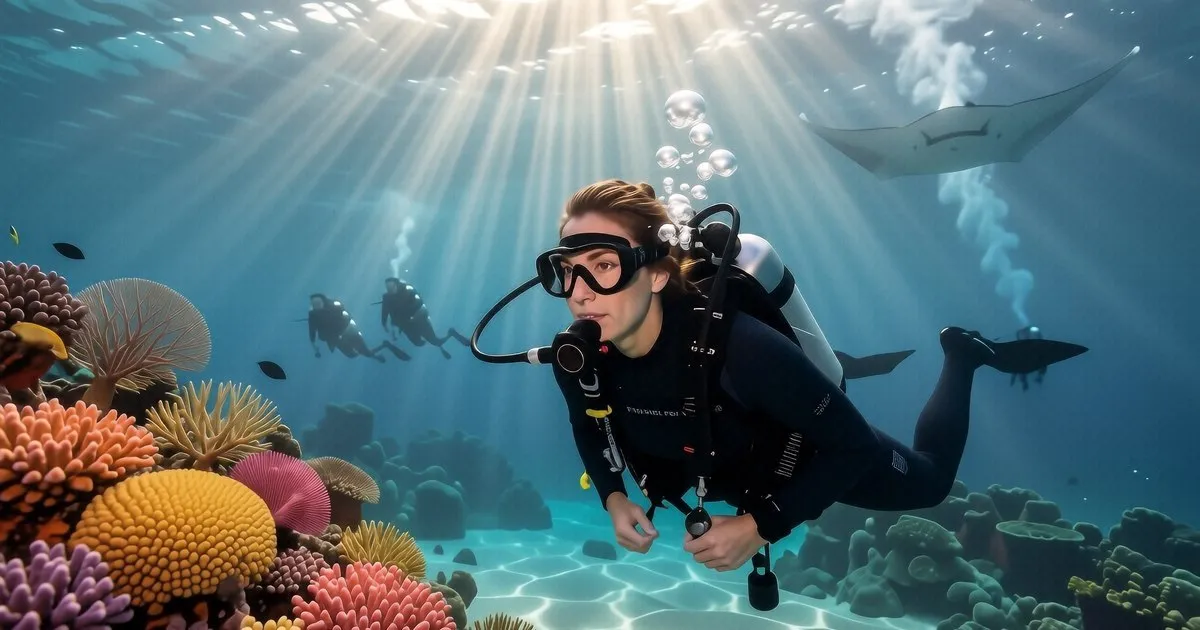
The failure of Valsalva
Valsalva is common in scuba. Most PADI or SSI divers use it naturally because they blow air from their lungs. This method fails quickly. Once you pass 20m, the pressure on your ribcage makes it very hard to move air upward. I felt this myself during a dive in Koh Tao back in 2016.
Your chest becomes tight. You cannot force air through the tubes because the volume of your lungs is shrinking rapidly. This physical limit is why many beginners hit a wall at 20m or 25m. It is not a lack of lung capacity. It is a mechanical failure of the Valsalva method.
Understanding the Frenzel mechanism
Frenzel uses your tongue. Instead of using your lungs, you use the tongue as a piston to push air into the middle ear. This requires a closed glottis. You must keep the airway to your lungs sealed off during the movement. It works much better.
Think of a syringe. The tongue acts like the plunger that moves the fluid. You create pressure in the back of the throat while the lungs stay still. This technique is efficient. It allows you to equalize even when your lungs are highly compressed at 30m or 40m.
Many divers struggle initially. They often try to use their chest muscles anyway. This creates a messy hybrid movement that does not work well. You need to isolate the throat muscles. Practice this in front of a mirror so you can see your neck movements.
Mastering the tongue piston
Your glottis must stay closed. If the glottis is open, no pressure builds up behind the tongue. This is the most common mistake I see. The air just escapes back into the lungs instead of moving up. It feels frustrating.
Start with dry training. You can use a Frenzel trainer or even just your fingers to block your nose. Press the back of your tongue against the soft palate. Then, pull the tongue down quickly. This creates the necessary pressure spike for the ears.
It takes repetition. I suggest practicing for 15 minutes every morning for at least 30 days. You will notice a difference in how your ears react. Consistency is the only way to build this muscle memory. Do not rush the process.
Moving toward mouthfill equalization
Frenzel works until your lungs are too small. This usually happens around 30m to 40m depending on your lung volume. At this point, you need a mouthfill. This is the next logical step for deep divers. It is difficult.
Before you reach that depth, you must gulp a large amount of air. You store this air in your cheeks and mouth. Once you swallow it, you seal the glottis forever. You then use that small pocket of air to perform Frenzel maneuvers. This is how professionals go deep.
It requires extreme control. If you lose that air, you cannot get more from your lungs because they are too compressed. Most students at AIDA courses learn this in the advanced modules. It is a high-stakes skill. You must be calm.
The role of FRC dives
FRC stands for Functional Residual Capacity. An FRC dive is a training method where you exhale before diving. This simulates the feeling of being deep. It makes equalization much harder. It is a useful tool.
By diving on low lung volume, you force your brain to manage pressure early. This helps you master the Frenzel technique under stress. You should not do this every day. Overdoing FRC dives can lead to lung squeezes or extreme discomfort.
I used FRC drills in Anilao to prepare for deeper dives. It helped me realize when my technique was failing. If you cannot equalize on an FRC dive, you will certainly fail at 40m. Use it sparingly. Safety comes first.
Common mistakes and how to fix them
Many divers use too much force. They try to ‘blast’ the air into their ears with high pressure. This can cause barotrauma or even ear damage. You should use gentle, rhythmic movements instead. Softness is key.
Another mistake is the ‘open glottis’ error. As mentioned before, if your throat is open, the piston fails. You might feel like you are trying, but nothing happens. Close your throat. Check your anatomy in a mirror.
Some people also forget to relax. Tension in the jaw or neck prevents the tongue from moving freely. If your neck is stiff, the Frenzel will be clunky. Relax your face. Breathe deeply before you descend.
Training schedules and progression
Do not dive deep every day. Your body needs recovery time to manage the physiological changes. A good schedule involves two or three heavy training days per week. This prevents burnout. Rest is productive.
Dry training is your best friend. You can do this while sitting on a bus or at a desk. Use a specialized tool like an Otovent to practice the pressure mechanics. It provides immediate feedback. It is very effective.
Progression should be slow. If you can equalize comfortably at 20m, move to 25m next week. Do not jump from 15m to 40m in a single session. This is how injuries happen. Listen to your body. Every diver has limits.
Safety and physiological risks
Equalization is about pressure management. If you feel pain, stop immediately. Pain is a warning sign of potential ear damage. Never push through an ear squeeze. It can cause permanent hearing loss.
Follow the guidelines from DAN regarding breath-hold diving. They provide excellent resources on the risks of hypoxia and barotrauma. Understanding the science helps you stay safe. Knowledge is your best gear. Always dive with a buddy.
A buddy is mandatory for every dive. They must be trained in rescue techniques. If you lose consciousness, they are your only lifeline. Never practice deep FRC dives alone in a pool or the ocean. This is non-negotiable.
If you are currently struggling with equalization at 15m, spend two weeks practicing the tongue piston on dry land before your next trip to Cebu.
Frequently asked questions
Why does Valsalva stop working at depth?
Valsalva relies on chest pressure which becomes impossible once your lungs compress below 20m of depth. At these pressures, your intercostal muscles cannot physically push enough air into the Eustachian tubes.
How long does Frenzel training take?
Most divers need 4 to 6 weeks of daily dry practice. You should spend at least 15 minutes every day using a specialized equalization tool or a simple mirror.